Sunday, April 13, 2008

Blue Blub, Hangers, Atomic Love


Sandy Skoglund's work is best described as a dream world that has gone seriously askew. She takes photographs which take months to install. Sandy’s photographs are bizarre and weird but are interesting and fun to interpret and look at. She has many photos that stand out but there are some that just pop out. For example this one photograph titled Blue Bulb. In this photo the man stands out the most. At first glance, the man is what everyone would first see. In the photo the man is depicted as large and orange. She uses this color to make the character in the photo be the first object seen by the viewer. Skoglund displays the man on the left, in the forefront. In the background there is a room which seems to be further away from the man. This room has an orange ceiling, bed and curtains as well as blue walls and the blue bulb on the center of the ceiling. The blue bulb on the ceiling for which the photograph is named after is miniscule compared to the orange man. The orange man is also looking at the blue bulb. His facial expression shows that he is intrigued and confused by this bulb. To the ordinary viewer the bulb is not as interesting. Skoglund portrays the man with great detail on the face and the way his hand looks and located. The detail shows what the man is thinking and trying to express. The position of the man’s eyes allows the viewer to be intrigued by trying to find out what exactly the man is looking at. After glancing at the man, the blue bulb is brought to the viewer’s attention. Overall it is obvious that Skoglund wants the orange man and the blue bulb to be the main focus of her photograph. The two main colors blue and orange help to make those two objects stand out.

Another photograph taken by Sandy Skoglund is called Hangers. This photo is realistic yet very bizarre. Hangers are the main focus in this photo as mentioned in the title. Skoglund makes the hangers the focal point of the photo by creating hundreds of them all over the photograph. Picture this, a yellow room and chairs as well as a pink floor. Then there hundreds, if not more, two-dimensional blue hangers placed on the walls and floor. These hangers are repeated over and over again on the wall as well as on the floor. On the floor there is also a bucket with a couple of blue hangers in it. Even though the hangers on the wall are two-dimensional, they become three-dimensional as they fall and hit the bucket full of paint also as they fall on the chair. The chairs are on the forefront of the photo and placed awkwardly on the floor. In the background a door is open and a woman dressed in yellow pajamas is about to walk in. Sandy Skoglund overflows the room with the same item to make the painting seem surrealistic and dream-like.

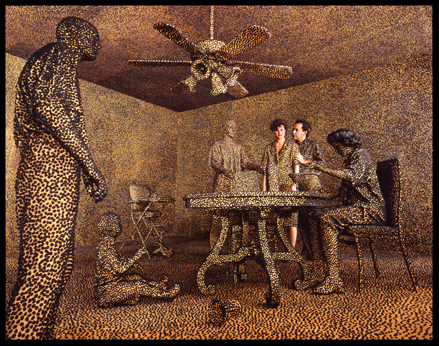
The photograph Atomic Love is another one her photos that seems realistic but with a twist included. The twist or irregularity of this photo is that the whole thing is in leopard print. Everything and everyone in the room is covered in print except for the faces and bodies of this man and woman in the background. The room including the walls, floor, ceiling, and ceiling fan are covered in animal print. In the forefront there is man that is depicted as tall and is facing in the direction of the regular man and woman. The tall man is also displayed in then side profile meaning that the viewer only sees one side of his face and body. On the floor there is a cup in front of the tall man. Then after the tall man there is a table. Next to the table on the right, in front of the tall man, is a baby sitting on the floor. To the left of the table there is a woman sitting on a chair. She seems to be making something in a pot. Behind the table there are three people displayed. Two of these people are a man and woman that are dressed in print clothes but their faces and bodies are not in print like the other individuals displayed in the photograph. The man in the photo is behind the woman and holding the woman’s arm as if to show affection. Then the other man is beside the woman on the left and is all in animal print like the other individuals in the photograph. He seems to be reaching out to the woman because of the way his arms are raised. The distortion in reality creates a surreal but odd and bizarre photograph. Sandy Skoglund in this photograph tries to portray the Atomic Love of these two people. The two people in the photo stand out because they are not covered in animal print. To show their Atomic Love, Sandy makes the two characters stand out in this animal print world.

Overall Sandy Skoglund creates this new world. All of her photos have people as well as animals included in it. In some of her works she creates photo’s that have an array of repeated objects like the Hangers photo. Skoglund likes to distort reality and eventually creates a dream-like situation. She also creates a photo that seemed to be of ordinary life but then gone seriously askew like the Atomic Love photo. Her ability to deform an ordinary photograph into something that is strange and doesn’t seem real is appealing and attractive to the viewer. Overall Sandy Skoglund’s work of art are creative and bring something fun and interesting to the viewer even though the process to creating these photographs takes a lot of time and energy. Each one of her photo’s focuses on something or someone and then that something or someone is put in a situation that that is out of the ordinary.

Friday, March 28, 2008

Act 3 Scene 1 Video Critique

The video that portrays the best interpretation of Hamlets soliloquy is the video under the direction of Laurence Olivier’s. Laurence best achieves the meaning of the soliloquy in the play through the use of sound, the tone of the actor and the background at which he chooses to set the moment in. Each of these provides the viewer with a better sense of what Shakespeare intended to do with Hamlet’s soliloquy. In Hamlet’s Soliloquy, Hamlet contemplates suicide and the director achieves this through this first video of the bog.

The video begins with a view of the ocean and its waves. This choice of scenery provides an in depth look at Hamlet’s mind. In the video Olivier portrays this by placing the actor in front of the ocean with his head turned back. Then the camera slowly approaches the back of Hamlets head symbolizing his stream of consciousness which is his soliloquy. Then the waves are featured as blurry and set right behind the image of the waves, Olivier chooses to place Hamlets forehead. As was mentioned in a previous scene of the play the waves symbolize Hamlets mind. Just like waves, hamlet’s mind moves in an up down motion. This motion reflects Hamlet’s personality and how it fluxuates depending on his state of mind. In the soliloquy Hamlet mentions the water by saying “…or by opposing arms against the sea of troubles, and by opposing, end them” (p.81 58-59). Finally the director took it upon his time to make the ocean and its waves a very important figure of Hamlets mind. Making the ocean the background for the soliloquy best portrays the state that Hamlet is in. It is almost as if the director is trying to pale the soliloquy as just another one of Hamlet’s motion of personality.

The music in the video also sets the mood of almost each line in Hamlet’s soliloquy. The music was fast, slow or suspenseful depending on which part of the soliloquy was acted. For example when the video first started out the music was very loud and had moments of high notes. Once Hamlet appeared the music became very eerie and almost provides a sense of fear. The music also provided the audience with mystery and suspense. The overall analysis of the Soliloquy is Hamlet’s contemplation of death as is stated in line 55when he says “To be, or not to be, that is the question”. In the whole passage Hamlet seems to be toying with the idea of suicide. Olivier puts this emotion in the video. This is done by first beginning the video with him overlooking the water, as if to show the chance of Hamlet jumping and purposely ending his life. Then the music becomes higher once again when Hamlet takes out his knife. As Hamlet is saying the lines “And by opposing, end them” the knife that he is holding is slowly approaching Hamlet’s body as if motioning the idea of killing himself. The music towards this scene is not only becoming louder and faster but it leaves the audience with the idea of will he or won’t he kill himself. In lines 59-64, the actor says in his mind portraying that the contemplation Hamlet has over ending his life. Finally the music at the end of the video provides the audience with a sense of sadness and desperation, as Hamlet slowly walks away from the edge of the cliff.

The tone that the actor chooses to portray the different parts is also equally important. The actors tone varies at almost every line of the soliloquy. At the moment when Hamlet takes out his knife his tone seems unsure. As the camera approaches Hamlet’s mind it seems as if the tone of the actor becomes weaker and also seems distant. After the camera pulls away from Hamlet’s face, his tone elevates to a scared and apprehensive one. This is done for effect to show that Hamlet is afraid to kill himself as he pulls the knife away and brings it toward his lower body. Overall the tone of Hamlet throughout the whole soliloquy in this video is calm until the moment when the knife is pulled out. The whole feel of the video as well as the actor’s tone has evolved.

In conclusion the video under Laurence Olivier’s direction portrays the best interpretation of Hamlet’s soliloquy in Act 3 Scene 1. The director and the actor focus on Hamlet’s emotions through the use of music, tone, and scenery. The first video is an absolute accurate portrayal of Hamlet’s soliloquy.

Tom Phillips: Explicating A Humument


On page 305 of Tom Phillips’ A Humument, Phillips creates an image of what remains when love and desire is gone. Phillips uses vibrant colors that stand out on the page. Each color creates an emotion of the main character, Toge. The colors range from dark to light. The dark colors symbolizing death and sadness. The light colors display a sense of healing, life and wisdom. Phillips also uses words to show the emotion displayed on the page.

Phillips starts the page by mentioning the state of the main character, Toge. In the portrait a figure resembling person is sitting by himself on a chair in what seems to be an empty room. He writes “only toge alone”. This is emphasized in the picture of the person sitting in the chair in an empty room.

Towards the middle of the page Phillips writes about the characters loneliness. He writes “loneliness is throb of my watch.” to describe his loneliness. The main character feels alone and empty but this brings Toge excitement and other emotions. His heart is beating faster. This is displayed in the color of the room. The vibrant colors provide the page with a sense of excitement. The canary yellow creates light and brings life into the room even though the character is red. The yellow provides the shriveled figure with life and a sense of moving forward as well as healing from the loneliness. The word “throb” is essentially related to the heart and the color of the figure sitting in the chair is similar to the color of a heart, red. The blood red could have a whole array of meanings like death, love, blood and passion. In this case it symbolizes love. This leads to believe that Toge was alone because he lost his love.

The next few words from the middle part of the page say “long shriveled aspiration”. In the literal sense the passage means that his loneliness is a helpless or useless desire. As he aims for what he wants, which is to get rid of his loneliness, Toge realizes that there is no use, the chance has withered away. In the painting this is created by making the figure of the man seem distorted and withered. The figure is shriveled and seems to almost be gone. Phillips also places the figure of the man sitting on the chair in front of what seems to be an open window. The open window symbolizes the “aspirations” that Toge wants to acquire. By placing the man in front of the window shows that he longs for something that he used to have or wants to have.

The last words of Phillips Humument create a sense that Toge maybe alone but he still has some things that he treasures. Phillip writes “my viola” as the first thing that he has been left with. The viola provides Toge with music and the emotion that he creates when using the viola. The instrument provides him with healing that he needs because he is alone. Then Phillips writes “the other thing your image I cannot get rid of it” as Toge’s second thing that he is left with. Even though he doesn’t have his actual love with him, he can still see what his love looks like. He has kept that image within him forever even though now he is lonely.

Overall, in this art piece Phillips displays an emotion that seems to be lasting. His loneliness is not forever as Phillips mentions that Toge has two things left. Phillips creates this through his painting. The vibrant colors bring life into the words. The colors of red and yellow help to make the words real. Red symbolizes the “throb” that he feels and yellow is the “aspiration” that he has lost. Phillips A Humument of page 305 is emotional but yet very exciting.

Reading Lolita in Tehran Discussions: First Session


I was wondering what you guys thought about how the author or Azar describes each character as they walk through the door of Azar’s home. The women have their own sort of identity. Some are dressed conservative and hesitate to take off their veils and scarves while others are relieved as soon as they walk through the door. Each woman is a different array of color in the sense that each brings a different personality to the class. For example Mashid is proper and very graceful. She is very quiet and doesn’t like to share her experience in jail. Maybe this class will allow Mashid to finally open up and be expressing. Another array of character is Nassrin.Nassrin is probably the most conservative character. She is very by the book meaning she follows the rules. All her clothes are dark colors and very huge. To me she seems to hide behind her dark clothes. The only bright thing about her is her face. She has a small, pale face that stands out because of her face. Her character too is very shy and traditional and conventional.The characters that stood out to me as free and very enthusiastic were Azin and Sanaz. Azin arrived to the class with the veil and black robe but as soon as she took them off, she looked carefree and casual. She was wearing jeans underneath and a white blouse. Along with that attire came earrings and lipstick. These things belongings were very unusual for a women in Tehran but the fact that she came to class wearing those clothes and accessories underneath means that she has been thinking about looking differently. Azin believes that the class will allow her to be carefree and not worry about what is right and what is wrong in Terhan. She can leave that life behind even if it is for an hour or more. That time is very precious to herSanaz is the other character that is very open and ready to be carefree. She too, like Azin, had different attire. She wore jeans as well and a bright orange t-shirt. When she takes the robe off she had “the most radical transformation”(16). The clothes made her look more radiant and made her features softer as opposed to being emancipated and almost stiff.